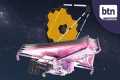
In September 2023, the James Webb Space Telescope turned its infrared spectrograph toward Jupiter's moon Europa — and what it found in the ice changed how scientists think about this world. Two independent research teams detected carbon dioxide concentrated in Tara Regio, a region of recently disrupted chaos terrain where the icy crust has been broken apart and refrozen. The carbon was not delivered by meteorites. It was not produced by surface radiation alone. Every line of evidence points downward — toward a buried ocean that may hold twice the volume of all of Earth's oceans combined.
This is not a story about finding life. It is something arguably more unsettling. Webb's data reveals that Europa's hidden ocean is chemically connected to its surface, depositing carbon and salt through cracks in geologically young ice. The more precisely we observe this moon, the less it looks like a distant possibility and the more it looks like a real, physically active ocean-world system whose chemistry is beginning to show through.
In this documentary, we explore what Webb actually observed, how infrared spectroscopy reads molecular fingerprints across hundreds of millions of kilometers, why chaos terrain matters, what the Galileo magnetometer discovered beneath the ice, how tidal heating keeps the ocean liquid, what the Juno spacecraft revealed about fractures hundreds of meters deep inside the ice shell, how carbon enters the ocean through seafloor water-rock chemistry, why Jupiter's radiation both destroys and creates the chemical ingredients for habitability, what Cassini found inside the plumes of Enceladus, and why Europa Clipper — now en route to Jupiter — will use Webb's chemical map to guide the most detailed investigation of an ocean world ever attempted.
Every measurement makes Europa harder to dismiss. Every finding closes another gap in the habitability argument. And the real disturbance is not what Webb found — it is that Europa was doing this the entire time, and we only just became capable of noticing.
Villanueva, G.L. et al. (2023). "Endogenous CO₂ ice mixture on the surface of Europa and no detection of plume activity." Science, Vol. 382. Endogenous CO2 ice mixture on the surface of Europa and no detection of plume activity
NASA — "Webb Finds Carbon Source on Surface of Jupiter's Moon Europa." NASA’s Webb Finds Carbon Source on Surface of Jupiter’s Moon Europa - NASA Science
Yoffe, G. et al. (2026). "Spectral Decomposition Reveals Surface Processes on Europa." arXiv preprint. JWST maps Europa's CO₂ beyond Tara Regio, hinting at subsurface exchange
NASA Europa Clipper Mission Page. Europa Clipper - NASA Science